Linnea Tanner is a creative author of historical fiction. I am honored to have her as a guest on my blog. Her books are well-written and researched. She is a member of the Rave Reviews Book Club and Rave Writers International Society of Authors.
Introduction
To understand the present and to seek alternative pathways for future social evolution, we must re-examine human history to understand how myths and religion support and perpetuate the social order it reflects. Since childhood, I’ve passionately read about ancient civilizations, legends, and mythology that spoke of a more harmonious and peaceful time when women and men lived together in partnership. A pantheon of gods and goddesses were worshipped.
Today, many of us view ancient beliefs and mythology as fantasy. Further, we may believe the presupposition that women have always been historically depicted as dependent and secondary to men. However, studying ancient art, archaeology, religion, mythology, social science, and historical records leads to a different conclusion. Evidence suggests ancient women were held in high esteem in many cultures and could serve many roles—ruler, priestess, healer, warrior, caretaker, and mother.
As the author of the Curse of Clansmen and Kings series, I’ve explored the spectrum of roles that women held and have extensively researched and traveled to sites described within each book.
World of the Goddess
Archaeological findings and mythology point to an era where our prehistoric ancestors solely worshipped the Mother Goddess. Neolithic art portrays a rich array of symbols from nature that is associated with the worship of the Goddess and attests to the awe and wonder of the beauty and mystery of life. Everywhere—in murals, statues, and votive figures—there is the image of the divine Mother cradling her child. In the shrines of the Neolithic settlement of Catal Huyak (approximately 7000 BC), female figurines were found near the shrines.
Often the Goddess is surrounded by powerful animals such as leopards and particularly the bulls. As a symbol of the unity of all life in nature, she is sometimes represented as part human and part animal. Just as all life is born from her, it also returns to her in death to be once again reborn. Worldwide, the deification of the female in the various ancient civilizations was probably based on her biological ability to give birth and to nourish as the earth does.
Minoan Society
One technologically advanced society where the Goddess was supreme was the Minoan society in Crete that was eventually displaced by warlike male gods. The destruction of the society provides a window on how a peaceful culture, whose social structure was based on the partnership between women and men, was catastrophically changed. Their social organization evolved from a matrilineal clan to a more centralized organization around 2000 BC, as a result of the agrarian economy changing to stock breeding, industry, and trade that contributed to its prosperity. Though the urban centers were technologically advanced, the architecture of the cities allowed Minoans the opportunity to enjoy nature.
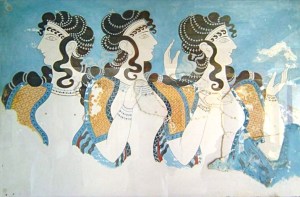
One of their entertainments was the bull-sport where young men and women working in teams would take turns grasping the horn of the charging bull and somersaulting over its back. These games vividly illustrate the partnership between women and men in this society.

Gods of War
What brought about the radical cultural change to the ancient Goddess society and how does this impact us today?
Beginning in 5000 BC, there was a long line of invasions from nomadic people from the Asiatic and European north. Ruled by powerful priests and warriors, they brought the male gods of wars, e.g. Ares, Greek God of War. Their social organization was based on male dominance which was characterized by acquiring material wealth through conquest and destruction. Around 1000 BC, the onslaught of these invaders was catastrophic. There was wholesale destruction of towns, of shrines, and of art. Masses of people were massacred and enslaved.
The cultural norm was men with the greatest power to destroy rise to the top; the social structure became hierarchical and authoritarian. Women who were closely identified with the old view of power symbolized by life-giving and sustenance were gradually reduced in status. The Goddess becomes the wife and consort to male deities who were associated with the destructive weapons and thunderbolts. And eventually, the Goddess disappears altogether in modern religion.
Golden Age of Celts
During the golden age of the Celts, their culture spread from Ireland to Turkey. Although the Celts were becoming more paternalistic, women were still held in high regard and could rule.
There is historical evidence that Celtic women fought in battles and took on military leadership. The Roman historian, Ammianus Marcellinus, described Celtic women in Gaul (modern-day France) as “…usually strong and with blue eyes; especially when, swelling her neck, gnashing her teeth, and brandishing her sallow arms of enormous size, she begins to strike blows mingled with kicks, as if they were so many missiles sent from the string of the catapult.”The Roman historian, Tacticus, writes the British were accustomed to women commanders in war. Boudicca was a warrior queen who united the Celtic tribes in Britain and almost expelled their Roman conquerors in 61 AD. She was also known as a powerful Druidess who Romans claimed sacrificed some of her victims to the war goddess Andaste.
The major female character, Catrin, in the Curse of Clansmen and Kings series embodies the complex archetypes of Celtic goddesses and historical figures. A Druid warrior princess, she derives mystical powers from her dual nature of absolute love and loyalty countered by her third for vengeance and destruction. She embodies the complex archetypes of Celtic goddesses as described below.
Celtic Goddesses
The Celtic goddesses embraced the entire religious spectrum from healing to warfare, from creation to destruction, and from nourishment to the Otherworld of the dead.
The Irish Celtic goddesses were associated with fertility and sovereignty. Many of the Irish goddesses were destructive and promiscuous and personified warlike strength to defend their land so it could flourish. Battle goddesses were invoked in times in war. They could shape-shift into ravens as harbingers of death.
Water is the life-force of goddesses, serving as the interface between the earthly and spiritual worlds. Many of the spring-sanctuaries in the Celtic provinces of the Roman Empire had goddesses as their patrons. One such site is located beside the river Avon at Bath, England. Long before Roman occupation, the site was considered sacred because of the hot, healing water associated with the goddess, Sulis, who is equated with the Roman goddess, Minerva.
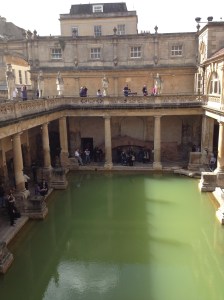
Similar to other ancient civilizations, the Mother Goddess was perhaps the most important of the supernatural deity as reflected by their images on friezes and statues. They symbolized the generative power of the female and are associated with symbols of the cornucopias, animals, and children.
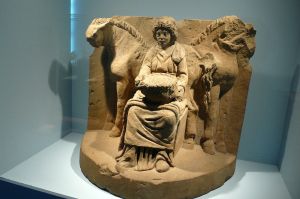
The concept of partnership is a prominent concept of Celtic religion and myth. At the time, the female is portrayed as the dominant partner. In early Irish and Welsh law, women could own their own property and had to consent to marriage. Irish myths telltale of marriage and divine love between a mortal king and goddess to assure the well-being of the lands. Images of male and female deities are represented as being the same size, with each of them having many functions. The female generally associates with domestic prosperity, fertility, and abundance.
Conclusions
Modern-day women can learn from ancient traditions and mythology to understand how they can embrace their complex but equal roles in society and marriage as a positive force. The Celtic goddesses were powerful entities embracing the entire religious spectrum from warrior to caretaker.
References
- Miranda Green, Celtic Goddesses: Warriors, Virgins, and Mothers; British Museum Press, London, 1995.
- Jean Markale, Women of the Celts; Inner Traditions International, Ltd, Rochester, Vermont, 1986.
- Riane Eisler, The Chalice and the Blade: Our History, Our Future; 1995; HarperOne: Imprint of HarperCollins Publishers, New York.
About Linnea Tanner

Since childhood, award-winning author, Linnea Tanner, has passionately read about ancient civilizations and mythology that held women in higher esteem, particularly the enigmatic Celts who were reputed to be warriors and druids. She has extensively researched and traveled to sites (United Kingdom and France) described in the Curse of Clansmen and King series.
A native of Colorado, Linnea attended the University of Colorado and earned both her bachelor’s and master’s degrees in chemistry. She lives in Windsor with her husband and has two children and six grandchildren.
Connect with Linnea Tanner at:
Website: https://www.linneatanner.com/
Amazon Author Central: https://www.amazon.com/Linnea-Tanner/e/B01N6YEM04
Bookbub: https://www.bookbub.com/profile/linnea-tanner
Twitter: https://twitter.com/linneatanner
Books by Linnea Tanner
Book 1: Apollo’s Raven
A Celtic warrior princess is torn between her forbidden love for the enemy and duty to her people.
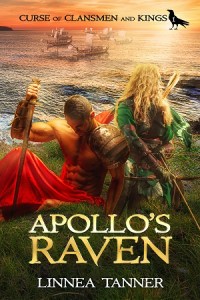
Pick up your copy of Apollo’s Raven today at:
Amazon: https://www.amazon.com/gp/product/B07GBHVZY7/
Barnes & Noble: https://www.barnesandnoble.com/w/apollos-raven-linnea-d-tanner/1125792731
Apple Books: https://books.apple.com/us/book/apollos-raven/id1424570213
Kobo: https://www.kobo.com/us/en/ebook/apollo-s-raven-1
Google Play: https://books.google.com/books?id=BXdoDwAAQBAJ&
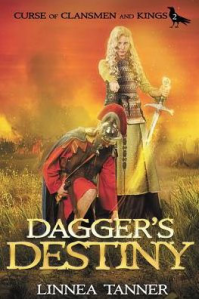
Book 2: Dagger’s Destiny
A Celtic warrior princess accused of treason for aiding her enemy lover must
win back her father’s love and trust.
Pick up your copy of Dagger’s Destiny today at:
Amazon: https://www.amazon.com/gp/product/B07G3G4G55
Barnes & Noble: https://www.barnesandnoble.com/w/daggers-destiny-linnea-tanner/1129214183?ean=2940161874004
Apple Books: https://books.apple.com/us/book/daggers-destiny/id1435211871
Kobo: https://www.kobo.com/us/en/ebook/dagger-s-destiny
Google Play: https://books.google.com/books?id=_4B7DwAAQBAJ
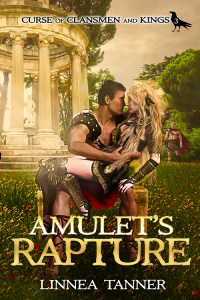
Book 3: Amulet’s Rapture
Blood stains her Celtic home
and kingdom. The warrior Druid princess will do anything to retake her kingdom.
Pick up your copy of Amulet’s Rapture today at:
Amazon: https://www.amazon.com/Amulets-Rapture-Curse-Clansmen-Kings-ebook/dp/B07Y8SS2B2
Barnes & Noble: https://www.barnesandnoble.com/w/amulets-rapture-linnea-tanner/1133754345?ean=2940161161845
Apple Books: https://books.apple.com/us/book/amulets-rapture/id1481106497
Kobo: https://www.kobo.com/us/en/ebook/amulet-s-rapture
Google Play: https://play.google.com/store/books/details/Linnea_Tanner_Amulet_s_Rapture?id=dkOxDwAAQBAJ
I hope you have enjoyed meeting Linnea Tanner and learning about her books. I have read and reviewed all three of them, each receiving well-deserved five stars. Please leave a comment which she and I both will appreciate. Thank you.
 KAREN INGALLS, AUTHOR, BLOGGER & SURVIVOR